Choosing a vessel is often treated as the final styling decision. In an experimental culinary studio, it deserves a place much earlier. The slope of a bowl affects where a sauce collects. A wide rim changes the apparent scale of a portion. Weight influences how a server carries the object and whether a diner feels comfortable lifting it. These are design conditions, not background details.
The most persuasive vessel does not need to disappear, but it should contribute deliberately. A strong sculptural form may suit one course and compete with another. An understated plate may provide clarity or feel indifferent. The question is not which object is most beautiful in isolation. It is which object makes this particular eating experience more coherent.
Begin with the action of eating
Describe what the diner needs to do. Will they cut, scoop, lift, pour or combine? A shallow bowl may gather a fluid element but make knife work awkward. A flat plate may support cutting while allowing a sauce to spread beyond the intended grouping. A narrow opening may concentrate attention yet prevent the spoon from reaching the final mouthful.
Use the intended utensils in the test, not whatever happens to be nearby. Check the contact angle, the sound of scraping and the ability to retrieve small pieces. Test from a seated position and with the vessel in its expected place on the table. A vessel that performs well on a standing workbench can behave quite differently at dining height.
Read objects beyond the restaurant
The ceramic work of Lucie Rie invites close attention to proportion, foot and surface. Hans Coper’s sculptural vessels prompt a different question about where a functional object ends and a sculptural encounter begins. These are design references rather than recommendations to serve food from collectible or unverified objects. An object’s artistic importance says nothing by itself about food-contact suitability.
The collections of the Victoria and Albert Museum and the Design Museum offer useful contexts for studying everyday objects as designed experiences. Sori Yanagi’s tableware and utensils provide another reference for the relationship between simple appearance and considered use. Study the decisions: where does the hand settle, how does the profile guide movement, and what does the object invite someone to do?
These references help a studio move beyond the false choice between plain white porcelain and a dramatic handmade object. Industrial precision and visible material character can both serve a dish. The important work is deciding which properties support the intended experience and which simply add visual noise.
Compare a small family of forms
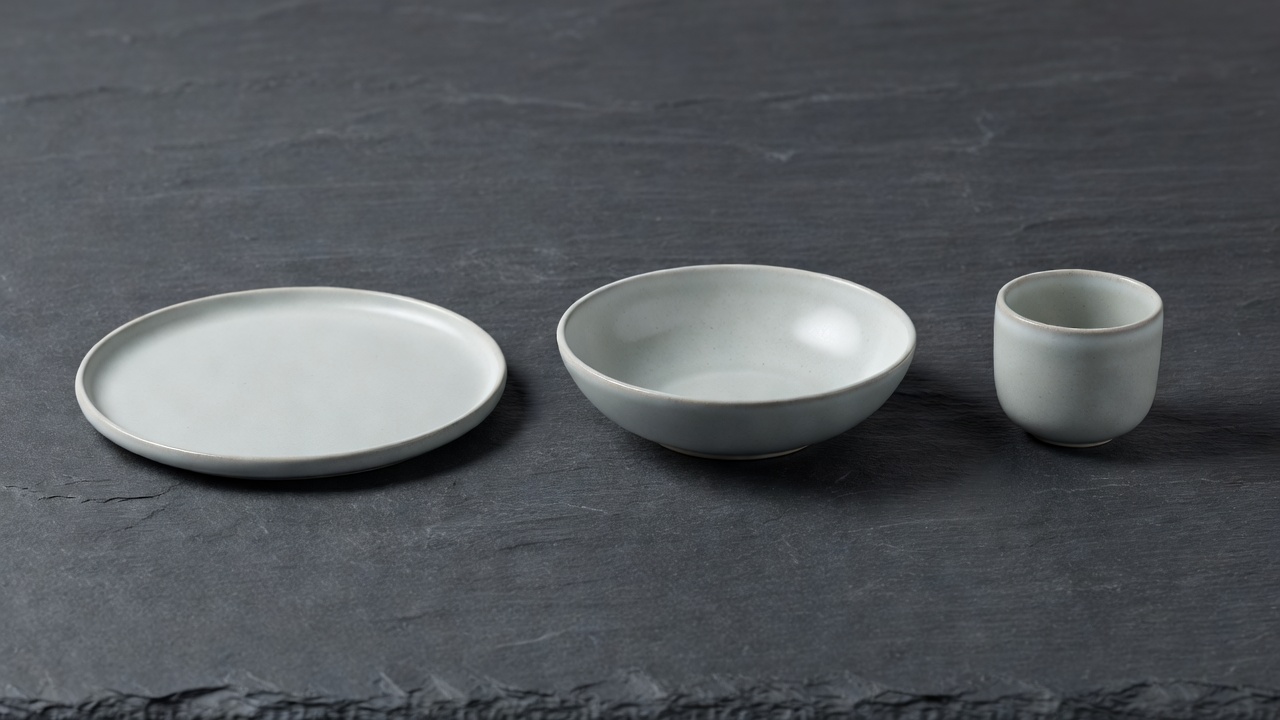
Place the same portion on a flat plate, in a shallow bowl and in a deeper vessel. Keep the food and lighting consistent. First assess the arrangement from above, then from the diner’s eye level. Record how much of the food is visible, whether components overlap and where liquid settles. Finally, eat from each vessel.
| Form | Potential contribution | Question to test |
|---|---|---|
| Flat plate | Open field and clear separation | Can the sauce and small elements be collected? |
| Shallow bowl | Gathering and gentle containment | Does the curve support the intended utensil? |
| Deep vessel | Concentration and partial concealment | Can the diner see and reach the full composition? |
| Shared platter | Collective presentation and choice | Can everyone access a fair, coherent portion? |
A vessel comparison should include service staff as well as the person designing the dish. Ask about grip, stability, stacking and clearing. An unusual foot may look convincing in a photograph and prove unreliable on a tray. An irregular rim may make repeated placement difficult. Such details are part of the design, not resistance to creativity.
Distinguish appearance from suitability
A matte finish may provide visual contrast, but appearance does not establish durability, cleanability or compliance. Obtain appropriate product information from the supplier. Ask about intended use, relevant food-contact documentation, cleaning requirements and limitations. A studio should not infer suitability from labels such as “natural”, “artisan” or “food inspired”.
The same caution applies to props that look edible or resemble serving objects. If a decorative support is part of a presentation, its role should be clear and its contact with food appropriately controlled. An inventive encounter should not depend on the guest guessing which surface is intended for eating.
Make the quiet decisions visible
Write a short vessel brief before buying a set. Include intended food, portion, utensils, carrying method, storage constraints and cleaning requirements. Add a sketch showing how the plate sits among cutlery, glasses and other courses. A large object may fit the dish perfectly and still make the table uncomfortable.
The final decision should be explainable in practical language: “The shallow curve gathers the sauce without hiding the crisp component.” That is a stronger reason than “It photographs well.” A vessel becomes a collaborator when its contribution can be felt in the eating, not merely recognised in the image.
Reference shelf
- Lucie Rie and Hans Coper, ceramic works represented in the Victoria and Albert Museum collections.
- Sori Yanagi, industrial design and tableware.
- Design Museum, for the study of designed objects and everyday use.
- Regulation (EC) No 1935/2004, on materials and articles intended to come into contact with food.